
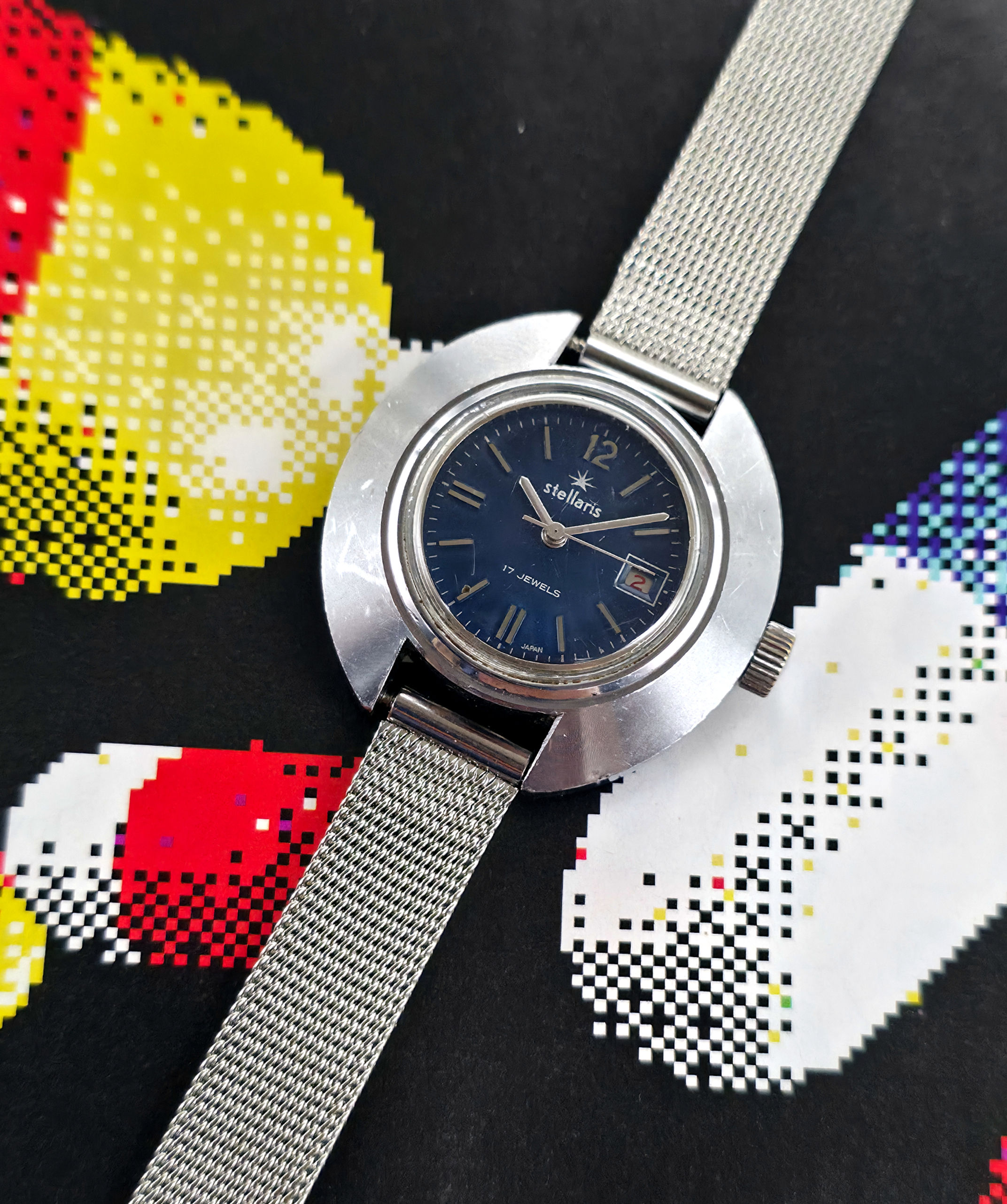

Stellaris was the in-house watch brand for Sears, Roebuck, and Company department store for years, incorporating Seiko and Swiss automatic and manual-wind mechanical movements - and this full-serviced 1960s Stellaris womens mechanical watch here is no different.
And we aren't the only ones that love Stellaris watches - Fratello's Mike Stockton noted about a similar-in-design Stellaris diver that, "It’s a watch with a likable dial, enigmatic branding, 'crippled' hour hand, juicy lume, and a cosmic treatment to the crown grip...this Stellaris is my kind of watch."
At its 1886 inception, American company Sears - run by Richard W. Sears, a railroad agent - sold watches by mail order catalog - much akin to Amazon at its founding selling books, pocket watches were Sears' first commodity, but it would gradually add substantially to its offerings - just like Amazon.
Although Seiko produced Stellaris for Sears, preceding this, Stellaris was a brand name registered in 1963 by Swiss brand Mondia; while not a well-known brand, it produced some intriguing watches, such as the Mondia “Big Eye” chronograph and the Top Second. It also put out a watch model called Stellaris with an unusual fluid case.
How did Mondia and Stellaris evolve to be separate watch brands? No idea – another mystery lost to the ages, akin to how both brands would become victims of the Seiko-initiated Quartz Crisis. Watch periodical Fratello speculated, “Mondia was used as support to make Stellaris trustworthy."
"Or, I suppose another possible scenario is that the Mondia Stellaris became so popular that Mondia decided to make it a separate brand featuring its own range of watches. And there were quite a few of them, mostly later Stellaris electronic models.” Regardless, the Stellaris font and symbol didn’t change after it was established as a stand-alone brand, the clearest evidence of the relationship between the two.
Aside from Swiss movements, Stellaris watches also featured Hamazawa Ltd – founded in 1954 – automatic movements, and Hamazawa had an unofficial relationship with Seiko. Further, in the 1970s, Hamazawa took out several joint patents with Epson (one of the three core companies of Seiko Group in contemporary times) on non-watch related items.
Hamazawa appeared to have sold a lot of movements to various Japanese and foreign watch companies, and in 1983, it merged with two other companies, one of which was a major watch case supplier for Seiko-Epson. Subsequently, in 1986, this company was taken over by Seiko.
Back again to Fratello's Stockton, "There are still little wonders waiting to be unearthed. Stellaris is one of them for sure. [] And since I landed this Stellaris, I haven’t seen another one."
This Stellaris mechanical comes on stainless-steel mesh bracelet, and with a dark blue and white nylon strap, rugged travel case, and springbar tool.
1960s Stellaris Ref. 8027A Women's Mechanical Watch
DIAL: Fantastic matte blue Stellaris-signed dial, with matching handset. Date feature works as designed (no quickset feature here, by design).
CASE: Steel case case measures 31mm (32.5mm w/crown) x 31mm.
CRYSTAL: Domed acrylic crystal, no cracks.
BAND: This Stellaris comes on a stainless-steel mesh bracelet, which will fit up to an approx. 7.50 inch wrist; it also comes with a dark blue and white nylon strap.
MOVEMENT: This Stellaris watch is powered by a 17-jewel Seiko/Hamazawa manual-winding ref. 8027A mechanical movement, reliable and easy to service. We have performed a full service on this Stellaris watch.
CROWN: Unsigned stainless-steel crown, with some wear.
