
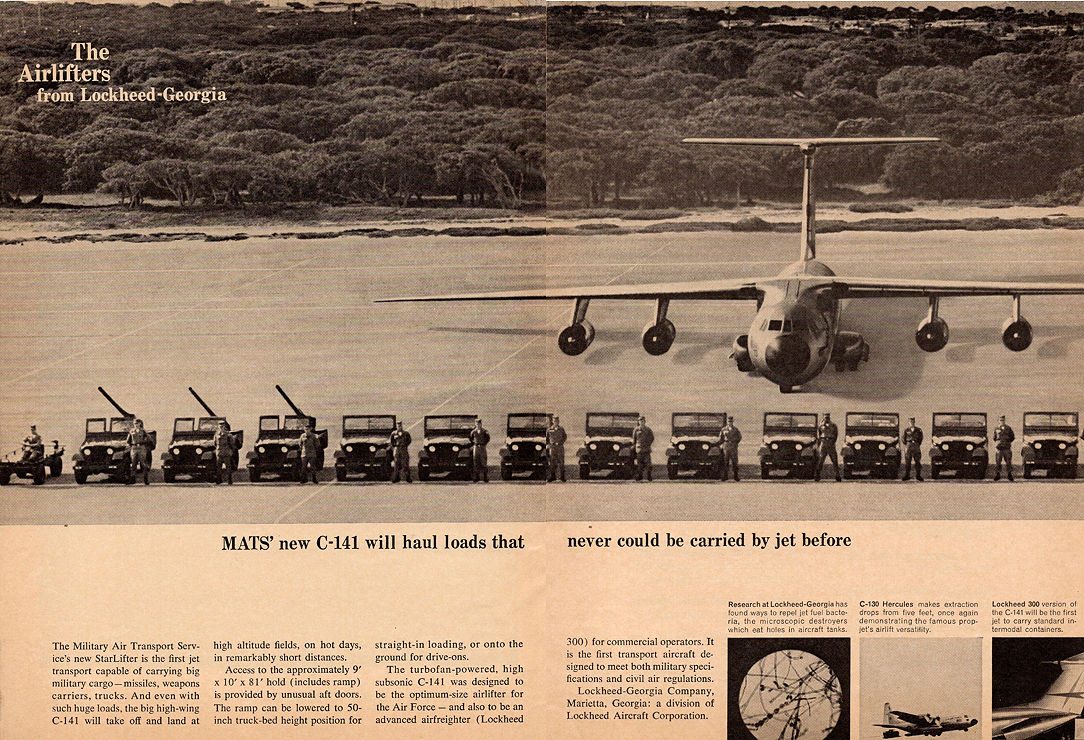

Original vintage 1964 Lockheed Aircraft Corporation advertisement for the company's iconic C-130 Hercules turboprop military transport aircraft - "What weighs 50 tons and can land in a bean field?"
Dimensions: Approx. 16 inches wide by 11.25 inches high - this is a two-page advert.
The Lockheed C-141 Starlifter is a retired military strategic airlifter that served with the Military Air Transport Service (MATS), its successor organization the Military Airlift Command (MAC), and finally the Air Mobility Command (AMC) of the United States Air Force (USAF). The aircraft also served with airlift and air mobility wings of the Air Force Reserve (AFRES), later renamed Air Force Reserve Command (AFRC), the Air National Guard (ANG) and, later, one air mobility wing of the Air Education and Training Command (AETC) dedicated to C-141, C-5, C-17 and KC-135 training.
Introduced to replace slower propeller driven cargo planes such as the Douglas C-124 Globemaster II and Douglas C-133 Cargomaster, the C-141 was designed to requirements set in 1960 and first flew in 1963. Production deliveries of an eventual 285 planes began in 1965: 284 for the USAF, and a company demonstrator later delivered to National Aeronautics and Space Administration (NASA) for use as an airborne observatory. The aircraft remained in service for over 40 years until the USAF withdrew the last C-141s from service in 2006, after replacing the airlifter with the C-17 Globemaster III.
Throughout the early 1960s, the United States Air Force's Military Air Transport Service (MATS) relied on a substantial number of propeller-driven aircraft for strategic airlift. As these aircraft were mostly obsolescent designs and the USAF needed the benefits of jet power, the USAF began development of the C-141, with the first delivery to an operational unit (63-8088) was conducted on 23 April 1965 to the 44th Air Transport Squadron, 1501st Air Transport Wing, Travis Air Force Base, California.
Although operational testing was still underway, as a consequence of the United States' military involvement in South Vietnam, the C-141 was quickly dispatched to the region to commence operational sorties within the combat zone. The type became heavily used throughout the latter stages of the Vietnam War, its transport capabilities being in high demand. Even following the arrival of large numbers of C-141s in the Vietnam theatre, the type was never able to replace the C-124 Globemaster II fully due to its inability to transport outsize equipment in-theatre; this situation was later addressed by the introduction of the even larger C-5 Galaxy. The final duties performed by the C-141 in the conflict were repatriation flights, bringing home thousands of American prisoners of war (POWs).
Despite some operational issues experienced, the C-141 formed the backbone of the USAF's strategic airlift capability during the late 1960s; it continued to hold this status through to the late 1990s. In early January 1966, following the disestablishment of MATS, all C-141s were transferred to the newly established Military Airlift Command (MAC).
The first strategic airlift flight of Operation Desert Shield was flown by a MAC C-141 of the 437th Military Airlift Wing out of Charleston AFB, SC, on 7 August 1990. A pact between the Indian government and the US also allowed US C-141 aircraft flying in materials from the Philippines to stop in Mumbai to refuel, which led to disquiet within most of the nation's formerly pro-Iraqi stance.
The C-141 proved to be a workhorse airlifter of Operations Desert Shield and Desert Storm, flying 159,462 short tons (144,661 t) of cargo and 93,126 passengers during 8,536 airlift missions. In order to provide sufficient C-141s to meet intense demands, all scheduled maintenance activities were postponed, while the planned peacetime flight hours of the fleet were doubled. According to a GAO report, weight-related operational restrictions imposed upon the fleet have little effect on performance overall. This airlift effort has been referred to as the largest in history.
In mid-September 2004, the C-141 left service with all active USAF units, being confined to Air Force Reserve and Air National Guard units for the final two years of its operational service life. Between 2004 and 2006, multiple C-141s assigned to the Air Force Reserve's 445th Airlift Wing (445 AW) at Wright-Patterson AFB were deployed to Iraq and Afghanistan, where they were typically engaged in the medical evacuation (MEDEVAC) mission to repatriate wounded service members.
There are 14 C-141s now on static display at various air museums around the United States. All other airframes were retired to the "boneyard" at Davis-Monthan AFB, Arizona, where they were scrapped.
Lockheed Aircraft Corporation
Headquartered in Bethesda, Maryland, Lockheed Martin is an American global aerospace company that employs more than 110,000 people worldwide. The defense powerhouse focuses on the design, development, and manufacturing of advanced technological systems. Serving the U.S. and International customers, Lockheed Martin offers products and services in many sectors such as aeronautics, Missiles and Fire Control, Rotary and Mission Systems, Communications, and more.
The Aeronautics sector focuses on researching, developing, and manufacturing advanced military aircraft, and it produces and provides support and sustainment services for the aircraft that they design and continue to upgrade. Some of the most famous aircraft include the C-130J Hercules, U.S. Air Force's F-22 fleet, and the Block 70F-16 for the Royal Bahraini Air Force.
