
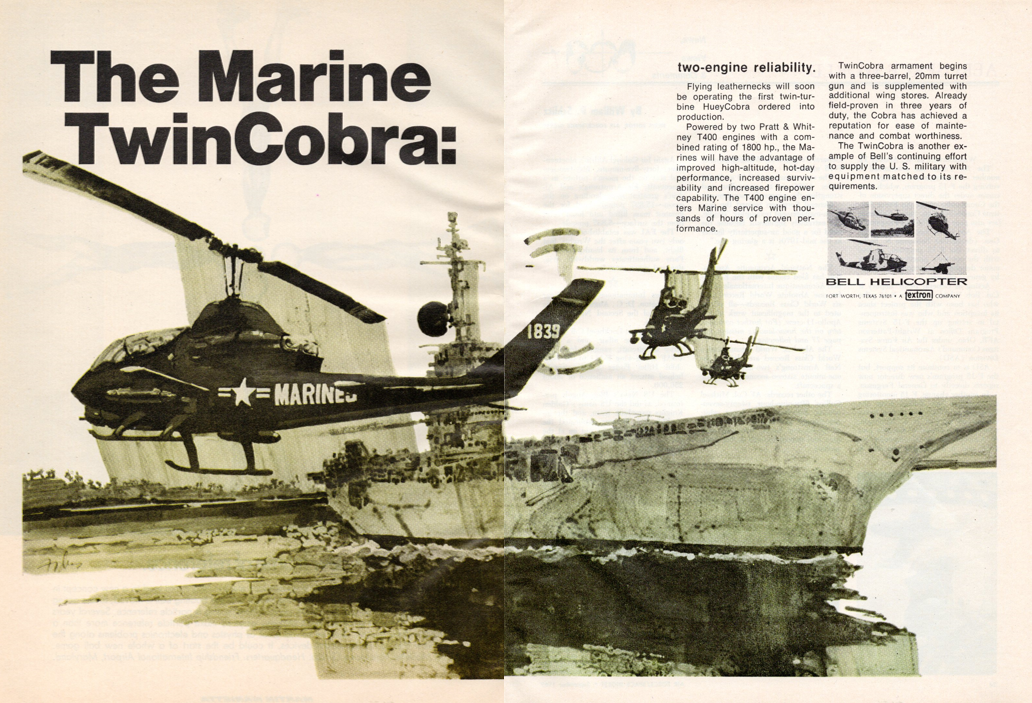

Original vintage 1969 Viet Nam conflict-era Bell Helicopter Company advertisement, featuring the U.S. Marine Cops Bell AH-1 SuperCobra attack helicopter - proclaiming "The Marine Twin Cobra: Two-Engine Reliability," Bell would build nearly 1,.300 of these in total.
Dimensions: Approx. 16.50 inches wide by 11 inches high - this is a two page advert.
The Bell AH-1 SuperCobra is a twin-engined attack helicopter that was developed on behalf of, and primarily operated by, the United States Marine Corps (USMC). The twin Cobra family, itself part of the larger Huey family, includes the AH-1J SeaCobra, the AH-1T Improved SeaCobra, and the AH-1W SuperCobra.
The Super Cobra was derived from the single-engined AH-1 Cobra, which had been developed during the mid-1960s as an interim gunship for the U.S. Army. The USMC had quickly taken an interest in the type, but sought a twin-engined arrangement for greater operational safety at sea, along with more capable armaments. While initially opposed by the Department of Defense, who were keen to promote commonality across the services, in May 1968, an order for an initial 49 twin-engine AH-1J SeaCobras was issued to Bell. The type entered service during the final months of the U.S.'s involvement in the Vietnam War, seeing limited action in the theatre as a result.
The USMC promptly sought greater payload capacity than that provided by the original Sea Cobra; thus the AH-1T, equipped with the dynamic systems of the Model 309 and a lengthened fuselage, was produced by Bell during the 1970s. In the following decade, in response to the denial of funding to procure the Boeing AH-64 Apache attack helicopter, the USMC opted to procure a more capable variant of the AH-1T; equipped with revised fire control systems compatible with new munitions, such as the AGM-114 Hellfire anti-tank missile. The new model, designated AH-1W, commenced delivery in 1986. Seeking to further develop the type, Bell opted to develop the extensively redesigned and modernized Bell AH-1Z Viper during the 1990s and 2000s.
The Sea Cobra was involved in multiple major operations during the latter half of the twentieth century, such as during the United States invasion of Grenada in 1983. During the Iran–Iraq War of the 1980s, Iranian Sea Cobras were intensely used, proving itself to be capable in both anti-armor and anti-aircraft warfare. Turkey, who operated numerous Cobras and Super Cobras, used the type on multiple occasions against Kurdistan Workers' Party (PKK) insurgents. On numerous occasions in the 1990s, USMC AH-1s were deployed during the Gulf War of the early 1990s, as well as for the United States invasion of Haiti in 1994, and the US intervention in the Yugoslav Wars in the late 1990s.
In the twenty-first century, the type also saw action in the multi-decade War in Afghanistan, and the 2003 invasion of Iraq. During October 2020, the USMC withdrew the last of its AH-1Ws in favor of exclusively operating the AH-1Z.
During the closing months of the United States' involvement in the Vietnam War, the Marine Corps embarked the AH-1J SeaCobra assigned to HMA-369 (now HMLA-369) aboard Denver, Cleveland, and later Dubuque, for sea-based interdiction of the Ho Chi Minh Trail in North Vietnam in the vicinity of Hon La (Tiger) Island. These were termed Marine Hunter-Killer (MARHUK) Operations and lasted from June to December 1972. As such, the type participated in the final American combat operations in Vietnam. Several AH-1Js were present to cover the evacuation of the US Embassy in Saigon in April 1975. During the Vietnam War, 306 AH-1 were destroyed.
During 1983, Marine Cobras took part in the invasion of Grenada. They were typically used to perform close air support and helicopter escort missions; a total of two AH-1Ts were shot down and three crew members killed. That same year, Marine AH-1s were also deployed off the coast of Beirut, Lebanon, amid the Lebanese Civil War in support of the Multinational Peacekeeping Force. In this theatre, the AH-1s were typically armed with Sidewinder missiles and guns, which were intended to be used as an emergency air defense measure to counter the threat of light civil aircraft being piloted by suicide bombers. During the mid-1980s, the AH-1W variant entered service with the USMC.[23] Between, 1986 to 1999, the service took delivery of 179 Super Cobras.[1]
In the late 1980s, in response to the Tanker War of the wider Iran–Iraq War, USMC Cobras were dispatched for Operation Earnest Will in the Persian Gulf to escort shipping and deter attacks upon them. It was during these missions that Cobras sank three Iranian patrol boats while losing a single AH-1T to Iranian anti-aircraft fire. USMC Cobras from Saipan flew "top cover" during an evacuation of U.S. and other foreign citizens from Liberia in 1990.
During the Gulf War, 78 Marine SuperCobras were deployed, flying a total of 1,273 sorties in Iraq. While no combat losses were reportedly incurred, three AH-1s were lost to accidents either during or after the combat operations. The AH-1W units were credited with destroying 97 tanks, 104 armored personnel carriers and vehicles, and two anti-aircraft artillery sites during the 100-hour ground campaign.
USMC Cobras were also used in various other operations throughout the 1990s. The type provided support for the U.S. humanitarian intervention in Somalia, Operation Restore Hope, during 1992–1993. They were also employed during the U.S. invasion of Haiti during 1994. USMC Cobras were used in U.S. military interventions in the former Yugoslavia in the 1990s; specifically, two AH-1Ws assisted in the rescue of USAF Captain Scott O'Grady, after his F-16 was shot down by a SAM in June 1995.
During the twenty-first century, USMC Cobras participated in Operation Enduring Freedom in Afghanistan and in Operation Iraqi Freedom in the conflict in Iraq. While new replacement aircraft were considered as an alternative to major upgrades of the AH-1 fleet, Marine Corps studies showed that an upgrade was the most affordable, most supportable and most effective solution for the Marine Corps light attack helicopter mission.
During the opening phase of the 2003 invasion of Iraq, SuperCobras were deployed on the front lines, often flying in hunter-killer teams with Bell UH-1 Iroquois utility helicopters and other coalition aircraft. Reportedly, 46 of the 58 USMC AH-1s deployed sustained battle damage, which was mostly from infantry-type weapons. AH-1Ws were also involved in the rescue of Private First Class Jessica Lynch from an Iraqi hospital.
In late August 2016, Marine AH-1W Cobras flying from USS Wasp started flying combat missions over Sirte, Libya against the Islamic State of Iraq and the Levant in Libya, providing close air support for friendly militias on the ground. In the later stages of the operation, AH-1Ws flew combat missions from the deck of USS San Antonio after that ship replaced Wasp in October 2016.
In October 2020, the U.S. Marine Corps retired the last of its AH-1Ws after 34 years of service, having replacing the type with the Bell AH-1Z Viper. By the time of their retirement, the model had collectively accumulated 933,614 flight hours.
