
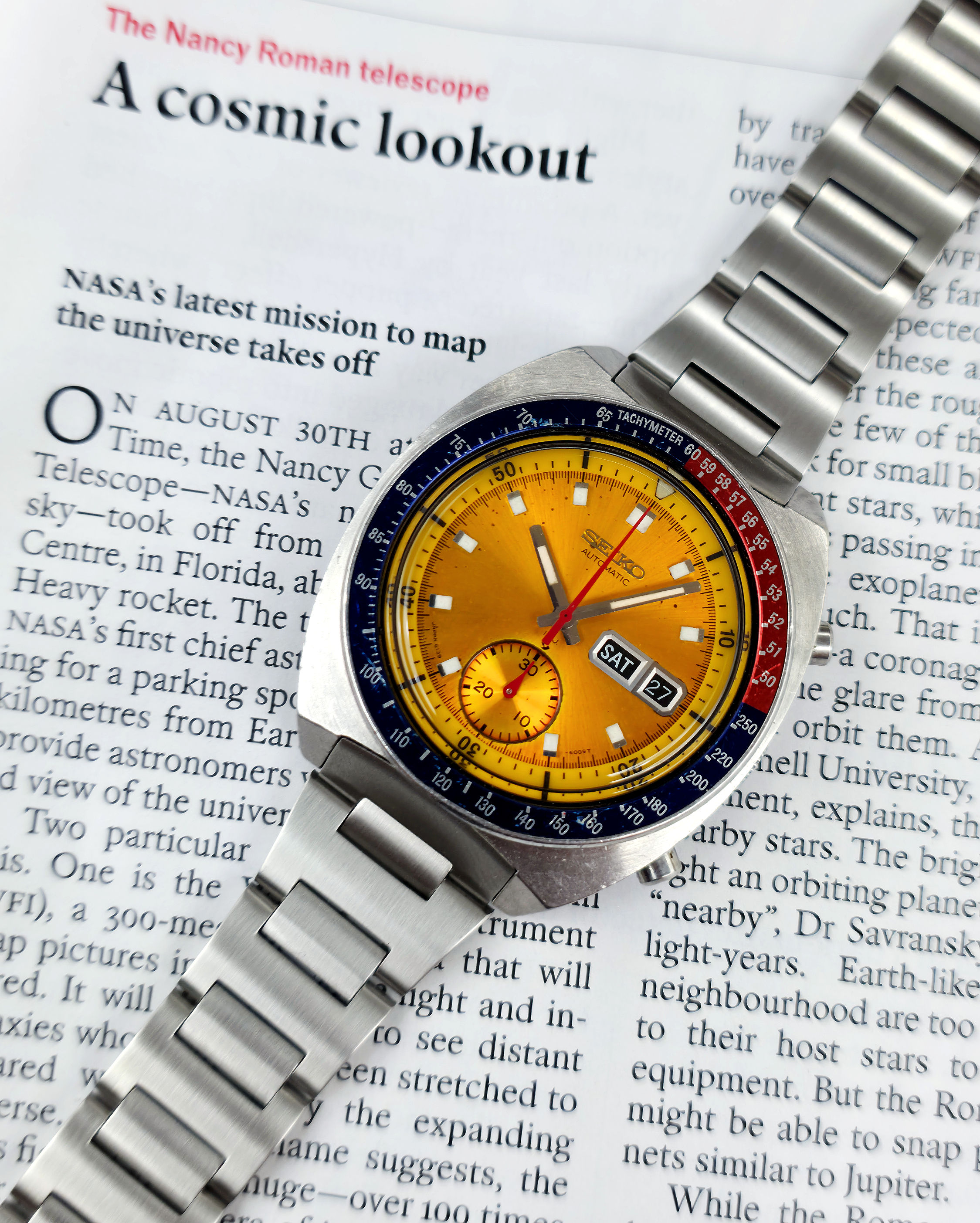

The Seiko 6139 automatic chronograph – a historical movement in its own right, like the full-serviced 1973 Seiko 6139-6005 "Colonel Pogue" automatic chronograph here, on a stainless-steel H-link bracelet – was the world's first automatic chronograph, beating out the likes of Zenith’s El Primero and Heuer’s Calibre 11.
The dial is one of the key highlights here, with little undue wear seen on lesser examples and a nice pearly white lume color throughout - with the sugar cube-like texture - we love to see on strong examples.
Back in the 1970’s, Heuer and Zenith had taken hold of the entire sports watch industry by racing to become the first to produce an automatic chronograph. It has been a feat debated who won, but in the background of this skirmish, Seiko quietly created one theirs at the same time, beating out all its competitors – the Seiko Calibre 6139.
Changing gears a bit, all of us know Omega was the first watch on the moon, mostly because Omega won’t let us forget (ever). However, the first automatic chronograph in space was the more humble and less publicized Seiko 6139-6005, named after U.S. astronaut Colonel William Pogue.
Colonel Pogue wore his USMIL PX-purchased Seiko 6139 on the 1973 Skylab 4 mission - despite not obtaining NASA authorization – to time Apollo spacecraft engine burns as the mission's pilot due to his familiarity with the watch (which he had worn during his training) and trust in its capabilities…entrusting the lives of himself and fellow astronauts to the reliability of his Seiko.
When asked about his 6139, Pogue confirmed the story per GQ Magazine, "I had been using the Seiko for well over six months (perhaps over a year) and had found it very handy for timing engine burns...the self-winding mechanism worked fine in zero-G.” Pogue would later sell his Seiko 6139 in a 2008 charity auction for a mere $6k.
Back to the Seiko calibre 6139 - during the early months of 1969, Seiko put the final touches on its revolutionary 6139 chronograph - in fact, the Japanese company first began putting the 6139 in automatic chronographs as early as January of the same year.
Seiko published its first advertisement for their new automatic 6139 chronograph in February 1969, easily beating the Swiss - however, the company was concentrating on the release of the world's first quartz watch, the Astron, which would completely disrupt the watch world as it was known at the time (again, much to the chagrin of the Swiss watch industry, we're certain). We possess 6139 dials dating back to November 1968, indicating Seiko beat all other rivals to produce the world's first automatic chronograph. Period.
The watch world recognized this recently, with an early model Seiko 6139 - January 1969, well before the Swiss - garnering nearly $20k at auction.
This Seiko Colonel Pogue comes on an Uncle Straps stainless-steel tapered H-link bracelet, and with nylon strap, rugged travel case, and springbar tool.
1973 Seiko 6139-6005 "Colonel Pogue" Automatic Chronograph
DIAL: Gold Seiko-signed sunburst dial, features light patina but easily legible and crisp writing; correct baton minute and hour hands, and chronograph hands on main and subdial retain their vibrant red color. Day/date – with Spanish/English variants – at 3 o’clock position works. Inner tachymeter ring thankfully features light wear and rotates smoothly, as designed. Lume on dial and handset feature no patina, and shine following exposure to strong light.
CASE: Stainless-steel case measures 41mm (w/o crown, 42mm with) x 46mm, and the case features sharp edges and no evidence of machine polishing. Matching caseback and red and blue “Pepsi” bezel insert evinces light wear but little UV fade, and remains in overall solid condition.
CRYSTAL: Seiko 6139-correct Hardlex crystal, no scratches or imperfections.
BAND: This Seiko 6139 comes on an Uncle Straps stainless-steel tapered "H-link" bracelet (the correct design for this era Colonel Pogue), which will fit up to an approx. 8.25 inch wrist; this automatic chronograph also comes with a maroon nylon strap.
MOVEMENT: Seiko 17-jewel 6139B automatic movement, manufactured in August 1973. We have performed a full service on this Seiko Colonel Pogue.
CROWN: Recessed unsigned stainless-steel crown.
CHRONOGRAPH PUSHERS: Chronograph pushers depress with satisfying click – no stick. Red chronograph main and subdial hands reset as designed to zero.
